
Most kitchens have a drawer of tools that almost work. These two are the opposite kind: single-purpose, cheap, and better than the general tool they replace — one because of the edge it leaves, the other because of the mess it prevents.
How a side-cut can opener actually differs
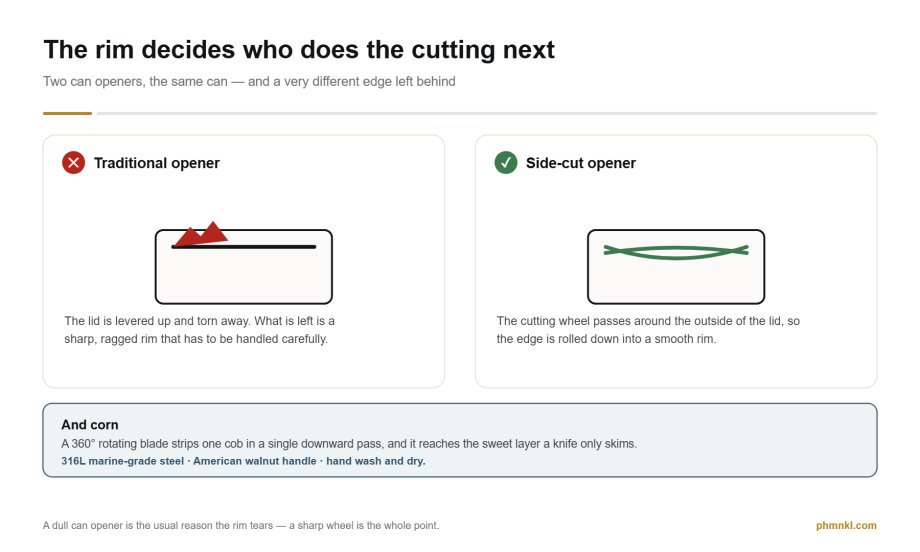
A conventional can opener pushes a blade down through the top of the lid, cutting a disc out and leaving a rim that is thin, jagged and genuinely sharp. Anyone who has reached into a sink of soapy water knows the result.
A side-cut opener works on a different principle. The cutting wheel engages the outside lip of the can and separates the lid from the body along the seam, rather than through the flat top. Two things follow:
- The cut edge is smooth, not serrated. The severed lid has no knife-edge rim, and the can’s interior lip is rolled rather than raw.
- The lid can be lifted off and set back on. Because the seam is intact on the lid side, a partially used can can be covered again — not sealed, but covered.
It is not magic. A side-cut opener needs the can lip to be clean and undented; a badly crushed can defeats it, and you will find yourself back at the old opener. It also takes a moment longer, because you are turning a knob around the whole rim rather than punching through in one lever motion.
Why the grips matter more than people expect
The most common reason someone stops using an opener is not that it broke — it is that squeezing the handles became uncomfortable. Grip strength declines with age and with conditions like arthritis, and a tool that needs a hard squeeze to keep the wheel engaged becomes painful long before it becomes unusable.
Soft, wider grips spread that pressure over more of the hand. Our side-cut opener uses them for exactly this reason, and it is the single feature most worth checking on any manual opener you buy. If a household has one person with weaker hands, this is the tool they will reach for.
Using one, start to finish
- Clamp the lip of the can between the wheel and the driving gear — the opener sits on the rim, not on the lid.
- Squeeze the handles together and hold them closed.
- Turn the knob steadily around the rim. You will feel resistance the whole way; that is the seam being cut, not a fault.
- When the cut completes, the wheel releases. Lift the lid off with the built-in tab.
Steady pressure beats speed. Turning fast tends to make the wheel skip, and a skipped section usually means starting the whole rim again.
Corn: why a stripper beats a knife
Cutting kernels off a cob with a chef’s knife works, and it makes a mess. The cob rolls, the kernels go everywhere, and the blade tends to take a slice of cob with it — which is why knife-cut corn often tastes faintly of wood.
A corn stripper is a ring with a blade at the top. You stand the cob upright on a board, seat the blade at the top, and pull down in one steady motion. The kernels fall where you put the board, the cob stays intact, and the cut is clean enough that the kernels stay whole rather than bursting.
Two practical notes: for frozen corn, give it a few minutes to thaw first — the blade cuts through fresh or cooked kernels, not solid ice, and forcing it will dull the edge. And cut over a bowl or a rimmed board, because a full cob releases more than you expect.
What 316L stainless steel means
Most kitchen steel is 304. The “L” in 316L means low-carbon, and 316 adds molybdenum — the element that resists chlorides. In practice, 316L is the grade used where salt and acid are present: marine fittings, medical instruments, and cookware that sees tomato and vinegar.
For a tool you use for two minutes a day, the difference shows up as pitting. Cheaper steel develops small dark pits where acidic corn juice or salty water sat, and once pitting starts the edge goes with it. 316L resists that, which is why the blade on our stripper is made from it rather than from whatever was cheapest.
The three tools
| Tool | What it does | Price |
|---|---|---|
| Side-cut can opener | Manual, side-cutting wheel, smooth rim, soft grips | $14.99 |
| Opener and corkscrew set | Same side-cut wheel, plus a two-stage waiter’s corkscrew | $13.99 |
| Corn kernel remover | 316L blade, 360° rotating head, American walnut handle | $14.99 |
Which to buy, honestly
If you open cans and drink wine, the set at $13.99 is the better value — it is a dollar cheaper than the opener alone and adds a corkscrew. The two-stage hinge on the corkscrew is the detail that matters: it levers the cork out in two steps instead of one, which is how you avoid snapping a brittle cork in half.
If you only open cans, the standalone opener is the same cutting mechanism in a smaller object that stores more easily in a crowded drawer.
If you cook with corn — even a few times a summer — the stripper is the tool that keeps earning its place. It is also the one people are most sceptical about before using it and most attached to afterwards.
Care, and the one thing that ruins them
All three are hand wash and dry. Not because the steel cannot take water — 316L is fine with water — but because the moving parts are the vulnerable bit. A dishwasher’s heat and detergent strip the lubricant inside the striker wheel and the rotating head, and a tool that turned smoothly starts to bind.
Wash in warm water with a little soap, dry immediately with a towel rather than leaving it in a rack, and store it dry. That routine is the whole of the maintenance.
Do not put them away wet, and do not use the opener on a can with a badly damaged rim — forcing it is how the wheel gets knocked out of alignment, and that is not something you can fix at home.
Frequently asked
Does a side-cut opener work on all cans?
On standard food cans, yes. It struggles with badly dented rims and with some non-standard shapes.
Are the lids really safe to handle?
The cut edge is smooth rather than knife-sharp, which is the point. It is still metal — treat it like the edge of a can, not like a plate.
Can the corn stripper handle frozen corn?
Let it thaw for a few minutes first. Cutting solid ice dulls the blade.
Is the walnut handle treated?
It is finished for kitchen use. As with any wood, do not leave it soaking.
Warranty?
Twelve months against manufacturing defects, 30 days to return. Full policy.
All three are in kitchen tools, with the specifications and current prices on each page.
In the catalogue
- Alloy key case for BMW — $28.99
- Cordless tire inflator, 150 PSI — $59.99
- 66W dual-port car charger — $25.99