
Car chargers are sold on one number — 66W, 100W, 30W — and that number is almost always the total across all ports, not what your phone gets. Here is how to read the label before you buy, and why a 66W charger can still charge a laptop slowly.
Watts, amps, volts — one sentence each
Volts are pushed by the supply (a car runs at roughly 12V, or 24V in some trucks). Amps are what the device draws. Watts are the two multiplied: W = V × A. A charger rated 66W can deliver 66 watts in total, split however its ports agree to split it.
That is why the headline number tells you less than you think. Two chargers both advertised as 66W can behave very differently: one might give 30W to a single USB-C port while a phone charges on USB-A, another might give 65W to one port but only 20W to the second.
PD, QC and PPS: what the letters buy you
- USB-C PD (Power Delivery) — the standard phones, tablets and laptops negotiate over USB-C. It is what makes fast charging on an iPhone or an Android flagship possible, and it is the only one of the three that can power a laptop.
- QC (Quick Charge) — Qualcomm’s standard, mostly on USB-A ports. Still extremely common on Android accessories and older phones.
- PPS (Programmable Power Supply) — a PD extension that lets the voltage fine-tune in small steps. Samsung’s “Super Fast Charging” uses it. A charger that lists PPS will hit full speed on more Samsung models than one that only lists PD.
A charger that lists PD and QC covers the devices people actually carry. One that adds PPS covers a few more. None of this matters if the cable cannot carry the current — more on that below.
The truth about multi-port chargers
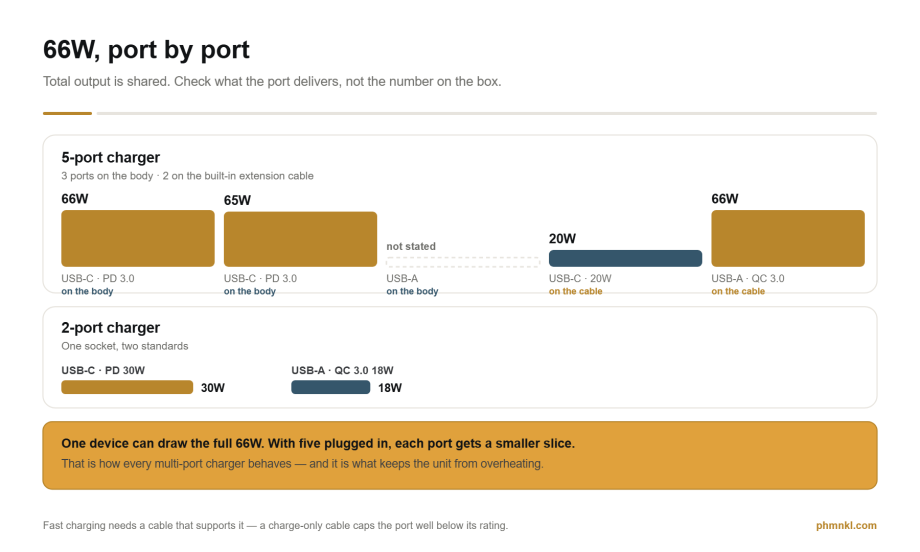
Total output is shared. The 5-port charger in our range is rated 66W + 65W + 20W across its USB-C ports, with the two extension-cable ports sharing that pool. A single device can draw the full 66W. Plug five in and each port gets a smaller slice.
This is how every multi-port charger behaves, and it is not a defect — it is how the unit avoids overheating in a socket the size of a thumb. The practical consequence: if you need one device to charge fast, give it a port on its own. If you are charging four phones overnight, the split does not matter at all because none of them are in a hurry.
Which one, for which car
| Dual-port 66W | 5-port 66W | |
|---|---|---|
| Ports | USB-C PD 30W + USB-A QC3.0 18W | 5 total (3 on body, 2 on extension cable) |
| Total | 66W | 66W + 65W + 20W across USB-C |
| Protocols | PPS · PD3.0 · QC4+ · QC3.0 | QC3.0 · PD3.0 |
| Build | PC + aviation-grade zinc alloy | — |
| Input | 12V–24V DC | 12V–24V DC |
Dual-port is the one for a single driver: one phone on USB-C at 30W, a second device on USB-A, and a metal body that survives being nudged every time you shift into reverse.
Five-port is for the family car or a work van — several phones, a tablet, and whatever else gets plugged in on the way to a game. The extension cable is the part that makes it genuinely useful: the ports reach the back seat instead of everything hanging off the dashboard.
Can either charge a laptop?
30W will keep a thin ultrabook topped up on a drive. It will not charge a workstation laptop, and it will not charge a gaming laptop at all — those want 65W to 100W and will either charge slowly or refuse. Check the laptop’s input wattage on its power brick before assuming any car charger will do the job.
If a laptop is the priority, the 5-port unit’s 65W USB-C port is the more realistic choice, as long as the laptop is the only thing drawing from that side.
The cable is half the charger
A thin charge-only cable — the kind that comes free with a cheap accessory — will cap a port well below its rating no matter what the charger can output. The symptom is specific: the phone says “charging” instead of “fast charging”, or it says fast charging but the battery creeps.
What you want is a cable rated for the current, typically marked 3A or 5A and USB-IF certified. Length matters too: a very long thin cable loses more in the run. If fast charging works at home with the same phone but not in the car, the cable is almost always the difference.
Heat, and why chargers slow down
A car charger lives in the hottest small space in the vehicle — a 12V socket next to a transmission tunnel, in direct sun in summer. Lithium-friendly charging circuits reduce current when they get hot rather than failing. If charging slows on a long summer drive, that is protection working, not a fault.
Two things help: leave a little air around the charger rather than burying it under a console lid, and avoid charging a phone that is also running navigation in direct sunlight with the screen at full brightness. The phone itself will throttle before the charger does.
What to check before buying
- Does the port you will use support PD? USB-A ports never carry PD; only USB-C does.
- What is the single-port maximum? That is the number that matters for your phone or laptop, not the total.
- How many devices at once, really? Count the phones in the car, not the ports on the box.
- 12V or 24V? All our chargers accept both, which matters for trucks and older diesels.
- Does your phone want PPS? Recent Samsung models charge noticeably faster with it.
Frequently asked
Will a 66W charger damage my phone?
No. The device negotiates what it can take; the charger supplies what is asked for.
Why does my phone show “charging” and not “fast charging”?
Usually the cable, occasionally the port protocol. Try a certified 3A+ cable first.
Do these work in a 24V truck?
Yes, both are rated 12V–24V DC.
Do they stay in the socket?
The dual-port model’s metal body adds weight where it helps. If your socket is worn, a slightly wider plug or a socket adapter is the fix.
Both chargers are in the car chargers category. If you tell us what you drive and what you charge, we will say which one makes sense — including when the answer is that a cheaper one does.
Read next
Charging is only half of what people add to a car. Where to mount a phone in a car compares the dashboard, windshield and vent positions, and the car chargers category lists both chargers with their port output.
In the catalogue
- Alloy key case for BMW — $28.99
- Cordless tire inflator, 150 PSI — $59.99
- 66W dual-port car charger — $25.99