
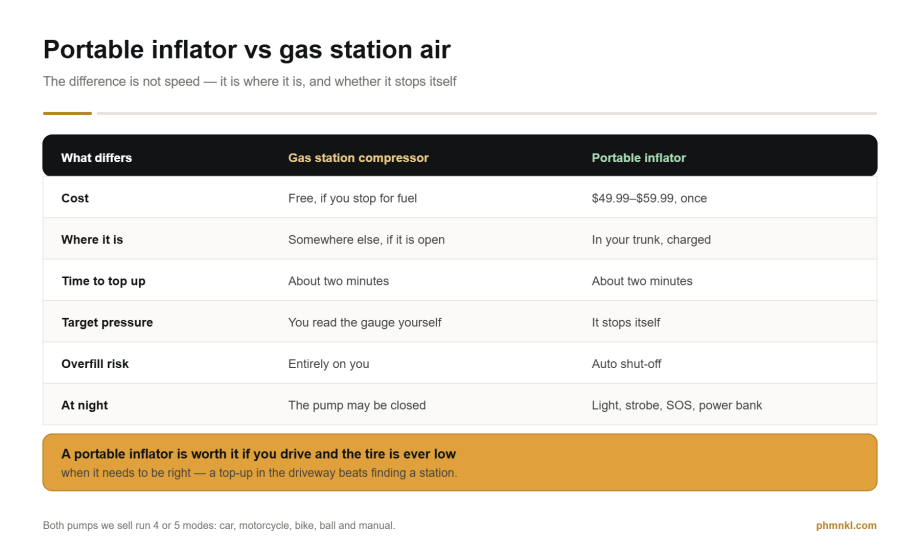
If you have ever topped up a tire with a gas station air hose, you already know the appeal: it is free, it is usually right there, and it takes ninety seconds. A portable inflator costs fifty or sixty dollars and lives in your trunk. Here is the honest comparison.
The short answer
The gas station compressor is fine for the once-a-year top-up when you happen to notice the tire on the way to work. It is a poor tool for the rest of your life, because it is somewhere else, it needs you to hold a nozzle against a valve, its gauge is often wrong, and it will not help you at 7am in a supermarket car park.
A portable inflator is worth it if you drive, if the tire is ever going to be low when it needs to be right, and if you would rather not go looking for a compressor first. That is most people, and it is not a close call for anyone who has been stranded by a tire on a motorway.
What a gas station compressor actually does
The green hoses at the pump work on a simple trick: air only flows while you hold the nozzle pressed against the valve. Put it down and it stops. That means the flow rate is whatever you can squeeze out by hand, and it means you are the flow control valve.
Three practical consequences. The hose delivers a fast, hot stream of air — fast enough to heat the valve and the inside of the tire if you fill a low tire too aggressively in one go. The gauge on an older public compressor is frequently a PSI or two optimistic, which is exactly the wrong direction to be wrong in. And the compressor has no idea what pressure you want, so overfilling is entirely on you.
None of this makes gas station air dangerous. It makes it something to use carefully, once, and not to rely on.
What a portable inflator does instead
A portable inflator does three things the hose cannot. It reads pressure continuously on a screen, so you stop at the number you wanted instead of guessing. It has a target setting, so it stops itself. And it has preset modes — car, motorcycle, bike, ball and manual — that cut off at the right pressure for each.
That last one matters more than it sounds. Running a tire a few PSI under is the most common way people damage one, and it happens because people eyeball a gauge that is hard to read in the dark or in the rain. A pump that stops itself at 34 PSI removes the entire failure mode.
When the gas station compressor is the right answer
- Your tire is a little low and you are passing a gas station on the way to work. Free is free.
- You already have a compressor at home. A second one is not a priority.
- You need one tire, once, and you already know the pressure you want. The number is on the door sticker.
When a portable inflator earns its place
| Situation | Gas station compressor | Portable inflator |
|---|---|---|
| Tire low before a long trip | You have to find a station, and it may be 20 miles away | Top it up in the driveway in about two minutes |
| Tire low at night, on a motorway | Not an option | It is in the boot, with a light |
| You do not remember the correct pressure | Shows you a number, but you still need the target | Car mode sets the target for you |
| You top up more than once a year | Fine, and free | Pays for itself in convenience alone |
How long a top-up actually takes
A tire that is a few PSI low takes about two minutes on a portable inflator. A tire that is properly flat takes longer: a high-torque cordless pump will take a car tire from 29 to 36 PSI in about sixty seconds. A gas station hose takes roughly the same time, and it is worth saying plainly — the difference is not speed.
The difference is that the portable one is in your car, works at 7am, stops itself at the right number, and does not make you crouch in the rain holding a nozzle against a valve.
Choosing between two portable pumps
If you have decided a portable inflator is worth it, you are choosing between the simple one and the one with more in it.
The straightforward cordless pump tops up a car tire in about two minutes, reaches 160 PSI, has a three-inch screen with live pressure, and runs four preset modes plus manual. It charges over USB-C and the hose and nozzle adapters come in the box. That is the 6000mAh portable inflator.
The one with more in it reaches 150 PSI in a working range of 3–160, holds the same 6000mAh, and is rated for up to twelve car tires on one charge. It also carries a three-mode light — spotlight, strobe and SOS — and a 45W USB-C output, so it will charge a phone from the same battery that inflated the tire. At 490 grams it still fits in a glovebox. That is the cordless inflator with the light and power bank.
If you only want a pump, buy the first. If you want one object in the boot that can handle a roadside at night, buy the second.
Questions we get asked
Is a gas station air compressor bad for my tire?
Not if you are careful. It fills fast, and fast filling can heat the valve and the inside of the tire, so add air in bursts and check the pressure as you go. The gauge on an older compressor can also be a PSI or two optimistic.
How often should I check my tire pressure?
Monthly, and before any long trip. A commonly quoted rule of thumb is about 1 PSI a month in typical temperatures, and a low tire wears the edges of the tread faster than the middle.
What pressure do I want?
The number on the sticker inside the driver’s door jamb or on the fuel filler flap — not the number on the sidewall, which is the maximum. Our inflator guide covers the difference in detail.
Can I use it for bikes and sports equipment?
Yes. Both pumps have bike and ball modes with the right target pressure built in, and the nozzles for balls and inflatables are in the box.
Do I need to charge it before a trip?
Charge it fully first. A pump that has sat in a cold trunk for months will have lost some capacity, and the first time you need it is the worst time to find that out.
Where to start
Both are in the tire inflators category. Free US shipping, 30-day returns and a 12-month warranty come with both — shipping and returns are here.
In the catalogue
- Alloy key case for BMW — $28.99
- Cordless tire inflator, 150 PSI — $59.99
- 66W dual-port car charger — $25.99