
Most people buy a tire inflator once, when a warning light comes on at the worst possible moment. This is what to check before that happens — starting with the only number that decides whether a pump is strong enough for your car.
The number that actually matters is not on the tire
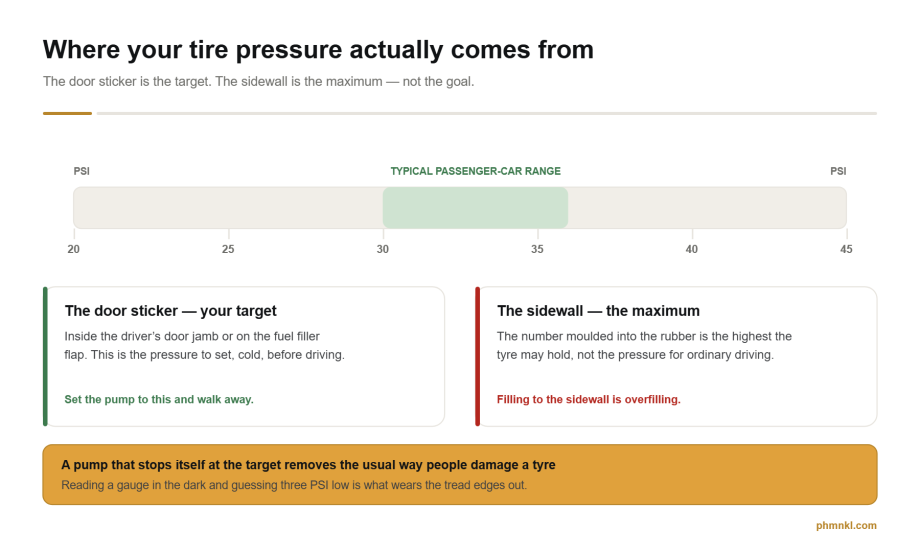
Look at the sidewall of your tire and you will find a big number like 44 PSI or 51 PSI. That is the maximum the tire can hold when cold — not what it should be. Inflating to that number is not just unnecessary, it makes the car ride harder and wear the centre of the tread faster.
The number you want is on a sticker inside the driver’s door jamb, or in the fuel filler flap. It lists the recommended pressure for your car, usually separately for front and rear, and often a higher figure for a fully loaded car. On most passenger cars it lands somewhere between 30 and 36 PSI. Check that sticker once and write the number down — it is the same number every time you top up.
This matters for buying decisions because a pump’s headline figure is its ceiling, not its working pressure. A 150 PSI pump is not “stronger” in any way you will notice topping up a 33 PSI tire. What you actually feel is how fast it fills and how long the battery lasts.
Corded versus cordless
The old default was a corded pump that clipped onto the battery or plugged into the 12V socket. It never runs out of power, which is genuinely useful, but it also means the hose has to reach all four wheels, the engine bay has to be open, and there is a cable to coil afterwards.
A cordless pump trades that certainty for convenience: pick it up, use it, put it back. The cost is battery management — a pump that has sat in a cold trunk since last winter will have lost capacity, and it will not tell you until you need it. Our own advice, printed on both product pages, is to give the unit a full charge every few months if it lives in the car. That single habit is the difference between a tool that works and one that disappoints.
Why a digital gauge changes the job
Filling a tire with an analogue gauge means crouching beside the wheel, watching a needle, and stopping at roughly the right moment. Three things make that better:
- A real-time digital readout — you see the pressure climb as it fills, not after.
- Preset pressure — you set the target once, and the pump knows when to stop.
- Auto shut-off — it stops at the target instead of you guessing. This is the feature that prevents over-inflation, which is the most common mistake people make with a fast pump.
The 150 PSI cordless model also reads in PSI, BAR and kPa, which matters if you travel or if your car’s sticker is in BAR — a common case on imported vehicles. Both of ours read in PSI by default, which is what US door stickers use.
The two models, and who each one is for
| 160 PSI model | 150 PSI model | |
|---|---|---|
| Max pressure | 160 PSI | 150 PSI (3–160 PSI working range) |
| Battery | 6000mAh | 6000mAh, rated to about 12 car tires per charge |
| Display | 3-inch LCD, real-time pressure | PSI / BAR / kPa |
| Modes | Car · Motorcycle · Bike · Ball · Manual | Car and general use |
| Extras | Upgraded air hose, nozzle set | 45W USB-C PD power bank, spotlight / strobe / SOS |
| Weight | — | 490 g, 16.5 × 6.7 cm |
Pick the 160 PSI model if your priority is a straightforward pump with five presets — car, motorcycle, bike, ball and manual. The extra headroom rarely gets used on a car tire, but it helps with van and light-truck pressures and with sports equipment that needs a hard fill.
Pick the 150 PSI model if you want one object in the trunk that does more than one job. It is rated to top up around twelve car tires on a charge, and the 45W USB-C output means it doubles as a power bank — enough to bring a phone back from dead. The spotlight is not a gimmick if you have ever changed a wheel at night; the strobe and SOS modes are there for the roadside case nobody plans for.
What neither of them is: a replacement for a proper compressor if you run air tools, or a fix for a tire that is losing pressure continuously. If a tire drops more than a couple of PSI a week, the problem is a nail, a valve or a bead seat — not the pump.
Using one without damaging the tire or the pump
- Check the target first. Read the door sticker, not the sidewall. Set that number as the preset.
- Thread the hose on straight. Cross-threading the valve is the most common way people create a leak while trying to fix one.
- Start the pump and leave it alone. With auto shut-off there is nothing to watch. Standing over it does not make it faster.
- Expect heat. The hose gets warm during a long run — that is normal, and the shielded sleeve on the 150 PSI model exists so your hand does not have to find out.
- Re-check with the pump off. A running pump reads slightly high. Once it stops, the reading settles to the true pressure.
Two habits worth keeping: inflate cold where possible (a tire that has just done twenty highway miles will read high), and never chase a target by repeatedly restarting the pump — if it is not reaching pressure, something is escaping.
What about bikes, balls and air mattresses
Both units ship with a nozzle set that covers the usual cases: a Presta/Schrader adapter for bicycles, a needle for balls, and a tapered nozzle for inflatables. The pump’s ceiling is far above what any of those need, so the limiting factor is care rather than power — a ball or an air mattress goes from firm to split in seconds. Set a low target and use the manual mode.
Storage and battery care
Lithium cells dislike two things: sitting completely flat, and sitting in extreme heat. A pump left at zero in a hot trunk through summer will not hold a charge the way it did when new. The routine that works is unglamorous — charge it fully, use it now and then, and top it up every few months whether you used it or not.
Store the hose coiled loosely rather than crushed under other tools; the fittings are the part that fails first on any inflator, and a kinked hose is how that starts.
Frequently asked
Can it inflate a completely flat tire?
Yes, given time. Seating a bead on a fully deflated tire sometimes needs more volume than a portable unit provides; if the tire will not hold air at all, the wheel needs to come off.
How accurate is the gauge?
Close enough for topping up, and consistent between readings — which is what matters. For competition or track use, use a dedicated gauge.
Will it run from the car while charging?
Both are cordless and charge over USB-C. You can charge from a car charger between uses, which is a reasonable habit if the pump lives in the car.
Does it come with a warranty?
Twelve months against manufacturing defects, and 30 days to change your mind. Full policy.
Both inflators are in the tire inflators category with current prices. If you are not sure which one suits your car, send us the door-sticker pressure and what you drive — we will tell you plainly.
Read next
Not sure a portable pump is worth having when a gas station air hose is free? Portable tire inflator vs gas station air compressor compares them on time, cost and safety. Every pump is in the tire inflators category.
In the catalogue
- Alloy key case for BMW — $28.99
- Cordless tire inflator, 150 PSI — $59.99
- 66W dual-port car charger — $25.99